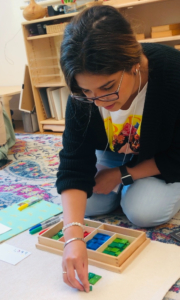
Betsy R. Cavagnaro
Betsy completed her Elementary I credential at WSMS-TEP in 2023. She currently works in a Lower Elementary classroom at Hudson Montessori School in Jersey City, NJ.
How did you discover Montessori, and what inspired you to pursue it?
I first discovered Montessori when I began working at Hudson Montessori School in 2018. At that time, I was completely new to the method, but I was deeply moved by the respect and care that Montessori places on each child’s unique potential. Working alongside my lead teacher, Sumaira, I witnessed not only her love for teaching but also her deep commitment to the Montessori philosophy. Her example showed me that teaching is more than instruction; it is a belief that all children have the power to shine.
After many years of working with children in various settings, from childcare centers to nannying, I knew I wanted to return to the classroom where I could grow as an educator. Discovering Montessori felt like the perfect fit. It combined my love for nurturing children with a philosophy that honors their individuality and fosters independence. That first experience at Hudson and the mentorship I received truly inspired me to pursue Montessori as both a passion and a lifelong path.
What’s one of your favorite memories from WSMS-TEP training?
One of my favorite memories from WSMS-TEP was the bond I formed with my Lower Elementary cohort. I remember feeling so nervous before the training began, unsure of what to expect. But the moment I saw my peers on Zoom, I knew I was in the right place. In just a few weeks, strangers became friends, and together we supported, encouraged, and lifted each other through every challenge.
What made it so special was the genuine kindness and collaboration that we felt, whether we were sharing a patient word, teaching each other, or working side by side. By the time we transitioned to in-person training, the experience only deepened, especially when we could hold the materials, present to one another, and learn together in the classroom setting.
This program not only provided me with the tools I needed as an educator but also fostered lifelong friendships and a genuine sense of belonging. I will always carry that with me and remain grateful to WSMS-TEP, my peers, and my instructors for making it feel like home.
What part of the Montessori classroom or curriculum excites you the most, and why?
The part of the Montessori classroom that excites me the most is, of course, the children. There’s something so special about that moment when they step into the classroom each morning, happy, curious, and ready to learn. They remind me every day that teaching is just as much about learning from them as it is about guiding them.
As for the curriculum, I’ve always been drawn to Cultural studies—zoology, botany, and astronomy—because they fill the classroom with wonder and connect children to the beautiful world around them. I also have a deep love for Language, especially the joy of discovering words, their roots, and the stories they carry. Seeing the children make those connections and get excited about what they’re learning is one of the best parts of my day.
How do you incorporate equity, inclusion, or social justice into your Montessori work?
Equity, inclusion, and social justice are truly at the heart of our classroom. We are such a beautifully diverse community, and I love that we get to honor and celebrate each child’s culture, traditions, and background together. It allows the children to see the beauty in one another and to feel proud of who they are.
Inclusion is something we live every day. We welcome children of all abilities, honoring each child’s unique needs and gifts. By meeting children where they are, we make sure they feel seen, supported, and truly part of our community. With patience and respect, we approach every child with the belief that they belong and that they have something meaningful to share.
Social justice begins with the simplest lessons, such as showing kindness, being fair, learning to listen, share, and respect one another. Even when we explore topics like the election process, the children begin to understand that their voices matter and that they have the right to be heard. For me, it’s about creating a classroom where every child feels they belong, and where love, respect, and community guide us in all we do.
Who was an important mentor during your training, and how did they impact your transformation as an educator?
I feel so lucky to have had several wonderful mentors during my training. The instructors at WSMS-TEP, Wyatt, Senead, and Sheba, were incredibly supportive. Their patience, encouragement, and guidance made such an impact on me. It never felt like they were “testing” us, but rather walking beside us, cheering us on, and truly wanting each of us to succeed. I carry their wisdom and kindness with me every day in my work with children.
Another mentor who is especially close to my heart is my co-lead, Ms. Dayelin. At the time of my training, she was my field supervisor, and today she remains one of the most important influences in my Montessori journey. She is Montessori: kind, patient, caring, and so deeply devoted to the children. I have learned, and continue to learn, so much from her example. I am endlessly grateful for her guidance, her knowledge, and the love she pours into this work.
What book, podcast, or resource is inspiring you right now?
Right now, I’m feeling inspired by The Wild Robot series, which I recently finished. Even though it’s a children’s series, I was completely captivated by the stories. I love how it celebrates love, teamwork, kindness, and the spirit of adventure. Reading it reminded me of the beauty of connection, the importance of working together, and how much we can learn from one another. Even though it isn’t a Montessori resource, it reflects so many of the qualities I love and value in teaching and in life.⠀